

Introduction: Awaken the Power Within
Allama Muhammad Iqbal, the great philosopher, poet, and visionary of the East, believed that human beings possess extraordinary potential. Yet, many remain unaware of their inner strength, living as though they were merely dust and clay when they have the capacity to rise toward greatness.
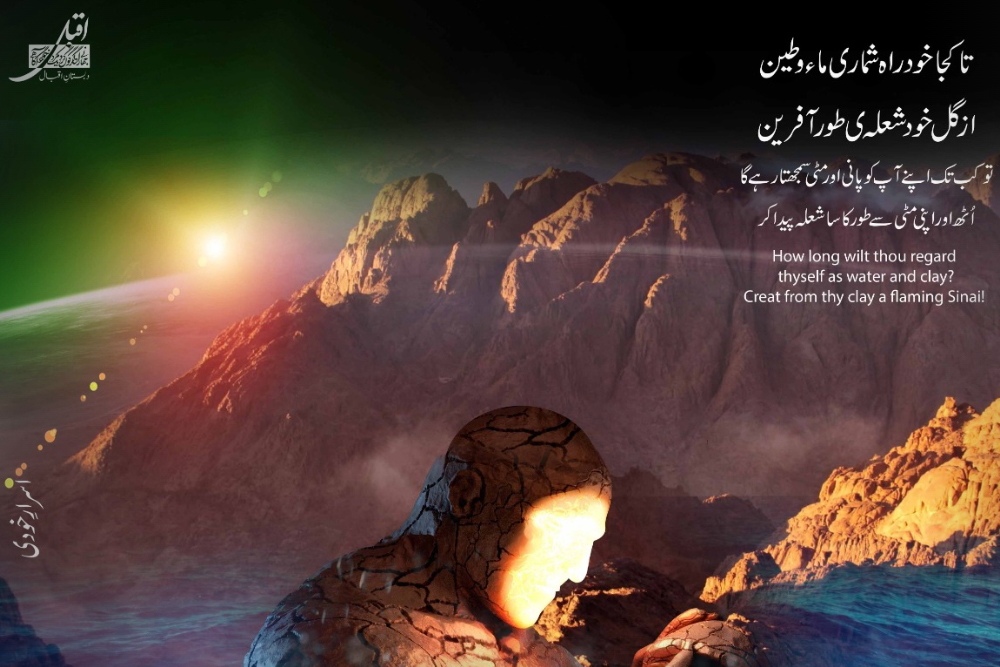
The image of a human figure emerging from cracked earth, illuminated by a powerful inner light, beautifully reflects Iqbal’s philosophy of Khudi—the awakening and development of the self. It represents the journey from weakness to strength, from uncertainty to purpose, and from spiritual slumber to conscious action.
Iqbal’s message is clear: do not underestimate yourself; discover your inner potential and transform it into meaningful action.
The Philosophy of Khudi: Discovering Your True Self
At the heart of Iqbal’s philosophy lies the concept of Khudi, often translated as selfhood or the realization of one's individual identity and potential. For Iqbal, Khudi does not mean arrogance, selfishness, or pride. Rather, it means developing a strong character, cultivating moral courage, pursuing knowledge, and building a purposeful relationship with the Creator.
Iqbal encouraged individuals to recognize their worth and take responsibility for shaping their own lives. He believed that a person becomes truly powerful not by dominating others, but by mastering their desires, overcoming fear, and remaining steadfast in their principles.
A developed Khudi enables a person to face adversity with courage, pursue truth with conviction, and contribute positively to society.
“How Long Wilt Thou Regard Thyself as Water and Clay?”
The words associated with the image express a central theme of Iqbal’s thought: the contrast between our apparent physical limitations and our immense spiritual potential.
Human beings are formed from earthly elements, but Iqbal challenges us not to define ourselves by our material origins or present circumstances. Poverty, failure, social pressure, and fear should not become permanent boundaries around our aspirations.
The reference to Sinai evokes the powerful imagery of Mount Sinai, associated with divine manifestation and spiritual illumination. The call to create a “flaming Sinai” from clay can be understood as a metaphor for transforming an ordinary existence into one illuminated by faith, knowledge, courage, and action.
It asks us to bring the fire of purpose into our lives and awaken the possibilities that lie dormant within us.
From Thought to Action: The Path to Transformation
Iqbal’s philosophy is not simply an invitation to dream. It is a call to act.
He believed that genuine transformation requires discipline, continuous learning, determination, and the courage to confront challenges. Knowledge becomes meaningful when it shapes our character and guides our actions.
In this spirit, the journey of self-realization involves:
-
Self-awareness: Recognize your strengths, weaknesses, values, and responsibilities.
-
Courage: Face difficulties without surrendering your principles.
-
Knowledge: Continue learning and question ideas in the pursuit of truth.
-
Action: Turn your aspirations into practical efforts that benefit others.
-
Faith and purpose: Build a life guided by moral conviction and spiritual awareness.
Through these qualities, the individual develops the strength to move beyond limitations and contribute to the progress of humanity.
The Individual and the Destiny of the Nation
Iqbal’s vision extended beyond personal development. He understood that the strength of a nation depends, in part, on the character and consciousness of its people.
A society cannot achieve its full potential when its individuals are trapped in hopelessness, intellectual stagnation, or dependence on others. Education, creativity, moral responsibility, and independent thought are essential for collective progress.
For Iqbal, awakening the individual was therefore closely connected to awakening the nation. When people develop confidence, cultivate knowledge, and work toward shared ideals, they help build a stronger and more enlightened society.
His message remains relevant to students, educators, artists, researchers, and young people seeking to create meaningful change in the modern world.
Iqbal’s Message for the Modern Generation
In an age shaped by digital media, artificial intelligence, and rapid technological change, Iqbal’s philosophy offers an important reminder: technology alone cannot define human progress. Character, imagination, ethical judgment, and a sense of purpose remain essential.
Young people must learn not only to use technology but also to think independently, create original ideas, and apply their abilities responsibly. The spirit of Khudi encourages them to become active creators rather than passive consumers, to develop their talents rather than imitate others, and to pursue excellence without losing sight of their values.
Whether through art, science, education, or entrepreneurship, the challenge is to transform potential into contribution.
Conclusion: Let Your Inner Light Rise
Allama Muhammad Iqbal invites us to look beyond our apparent limitations and recognize the possibilities within us. His philosophy of Khudi is a journey of self-discovery, moral development, spiritual awareness, and purposeful action.
The figure emerging from the clay in the image symbolizes this transformation: a human being moving from darkness toward illumination, discovering strength where there once appeared to be weakness.
The lesson is timeless: do not remain confined to what you are today. Cultivate your character, awaken your imagination, strengthen your spirit, and strive to become what you are capable of becoming.
Through the philosophy of Iqbal, the ordinary individual is challenged to pursue an extraordinary life—not for personal glory alone, but for the betterment of humanity.
Dabistan-e-Iqbal is dedicated to researching and promoting the thought, poetry, and philosophy of Allama Muhammad Iqbal, inspiring new generations to explore his intellectual legacy and apply its lessons to contemporary life.


israr
Sir, bohat acha likha. Iqbal ka 'Khudi' ka paigham aaj ke naye daur mein bhi utna hi zaroori hai jitna tab tha. Ma sha Allah. 👏